

Repair or Replace Dilemma: Service Business Decision Framework
How pros weigh temporary repairs, long‑term fixes, and full replacements, balancing safety, standards, cost, and environmental impact without sales pressure.
Quick Summary
- Rule of thumb: Repair if repair cost × system age in years is less than $5,000; replace if higher—but add context
- TCO equation: Compare 3-year costs including repair, likely follow-on repairs, and energy delta vs. replacement minus energy savings
- Temporary fix is ethical when: safe, low pressure/vibration, disclosed in writing, permanent options offered alongside
- Walk away when: structural integrity failing, high-pressure zones near compressor, electrical hazards, or combustion safety concerns
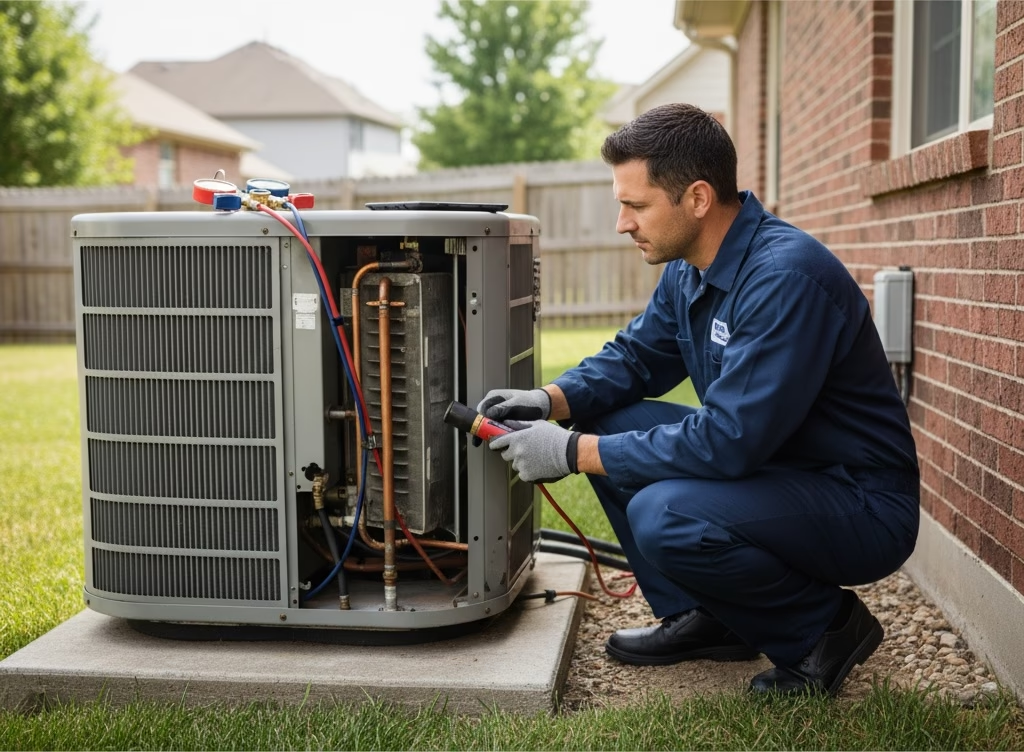
On a hot July afternoon, a tech faces a 12-year-old system with a failed compressor. Repair: $2,500. Replace: $7,500. The homeowner is on a fixed income, the attic is 120°F, and a storm is rolling in. What’s the ethical recommendation?
There’s no single formula. Field pros weigh safety alongside money, time, and context. Whether you’re managing an HVAC service business or starting one, this framework helps balance customer needs with professional standards.
TCO Calculator (Quick)
- Formula: 3‑yr TCO = repair now + expected follow‑on repairs + (energy cost with current SEER × 3 yrs) − (energy cost with replacement × 3 yrs)
- Example: $2,500 repair + $800 follow‑on + $4,200 energy − $3,100 energy if replaced = $4,400 vs replacement net. Choose the lower cost if safety and reliability are acceptable.
Temporary Fix Disclosure (Copy‑Paste)
“Today’s work restores limited operation. This is a temporary repair judged safe at current pressures/loads. We reviewed permanent options and their costs. We recommend planning replacement/repair by [DATE/CONDITION]. Please contact us sooner if performance declines or safety alarms occur.”
Standards vs. Field Reality
ACCA publishes quality installation practices. AHRI maintains performance certifications. Manufacturers specify approved methods for permanent repairs.
What they don’t cover: when a low-risk patch is acceptable or when a mid-life system deserves one last major repair. Two truths can both be valid:
- Permanent brazed repairs, pressure-tested and evacuated properly, are the gold standard
- With disclosure and sound judgment, a temporary fix can be the right bridge for customers who need time to plan replacement
Typical lifespan context (so repairs make sense)
The expected life of major components varies. Knowing the ranges helps you frame repair horizons and warranties without guesswork.
Typical HVAC Component Lifespan Ranges
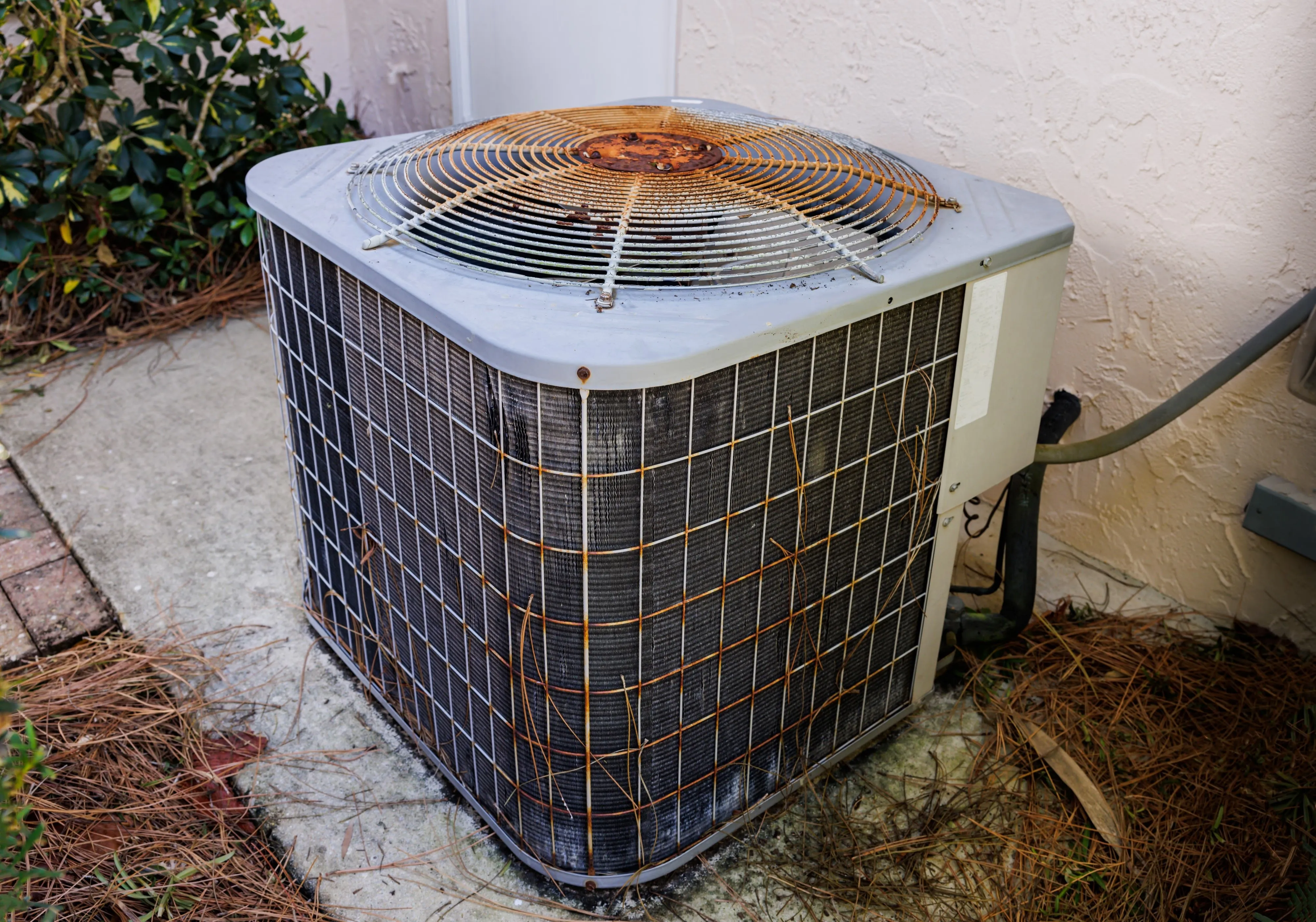
Visible rust and wear on a residential AC unit approaching end of service life
Lifespan alone doesn’t decide the case. Refrigerant type, structural integrity, safety, warranty terms, and customer risk tolerance all matter.
Beyond the $5,000 Rule
The age × repair-cost heuristic is a starting point, not a verdict. Add these factors:
- Safety/code — Never compromise electrical, combustion, pressure boundary, or ventilation. If it can’t be made safe, don’t do it
- Refrigerant — R-22 is often uneconomical due to phaseout costs; R-410A faces A2L transition
- Structural integrity — Rusted pans, rotted coil plates, or multiple leak points turn every repair into a new failure
- Efficiency delta — 10–12 SEER vs. 16+ SEER changes long-term operating cost significantly
- Warranty/recall — Verify serials and part coverage before recommending
- Downtime/access — Some “cheap” repairs require multiple attic days for marginal life extension
3-Year TCO Calculation
Present transparent comparisons customers understand in 60 seconds:
- Repair cost — Quoted price with warranty term
- Follow-on repair contingency — If integrity is marginal, add ~$600 (capacitor + contactor + refrigerant)
- Replacement cost — Installed price with labor warranty
- Energy delta — Old 10–12 SEER vs. new 16 SEER ≈ 30–40% annual cooling savings per DOE Energy Saver
Example (2.5-ton warm climate):
- Annual cooling (old): $1,000 → (new): $700 = $900 savings over 3 years
- Repair path: $2,500 + $600 contingency = $3,100
- Replace path: $7,500 − $900 energy savings = $6,600
3‑Year Total Cost Example: Repair vs. Replace
Assumes: $2,500 repair + $600 follow‑on + existing energy; $7,500 replace − $900 energy savings over 3 years. Illustrative only; use local costs.
The goal: replace vague adjectives (“old,” “inefficient”) with numbers customers can react to.

Regional Adjustments
- Coastal salt air — Accelerated corrosion; shorten temporary repair horizons
- Hot-humid climates — Longer seasons make efficiency gains more valuable
- Desert/high-dust — Coil fouling drives repeat service; add maintenance costs to repair path
- Cold climates with heat pumps — Include heating-season COP savings in TCO, not just cooling
Environmental Context
R-22 GWP: 1810 | R-410A GWP: 2088 | R-32 GWP: 675 (per EPA)
Global Warming Potential (100‑yr) of Common Refrigerants
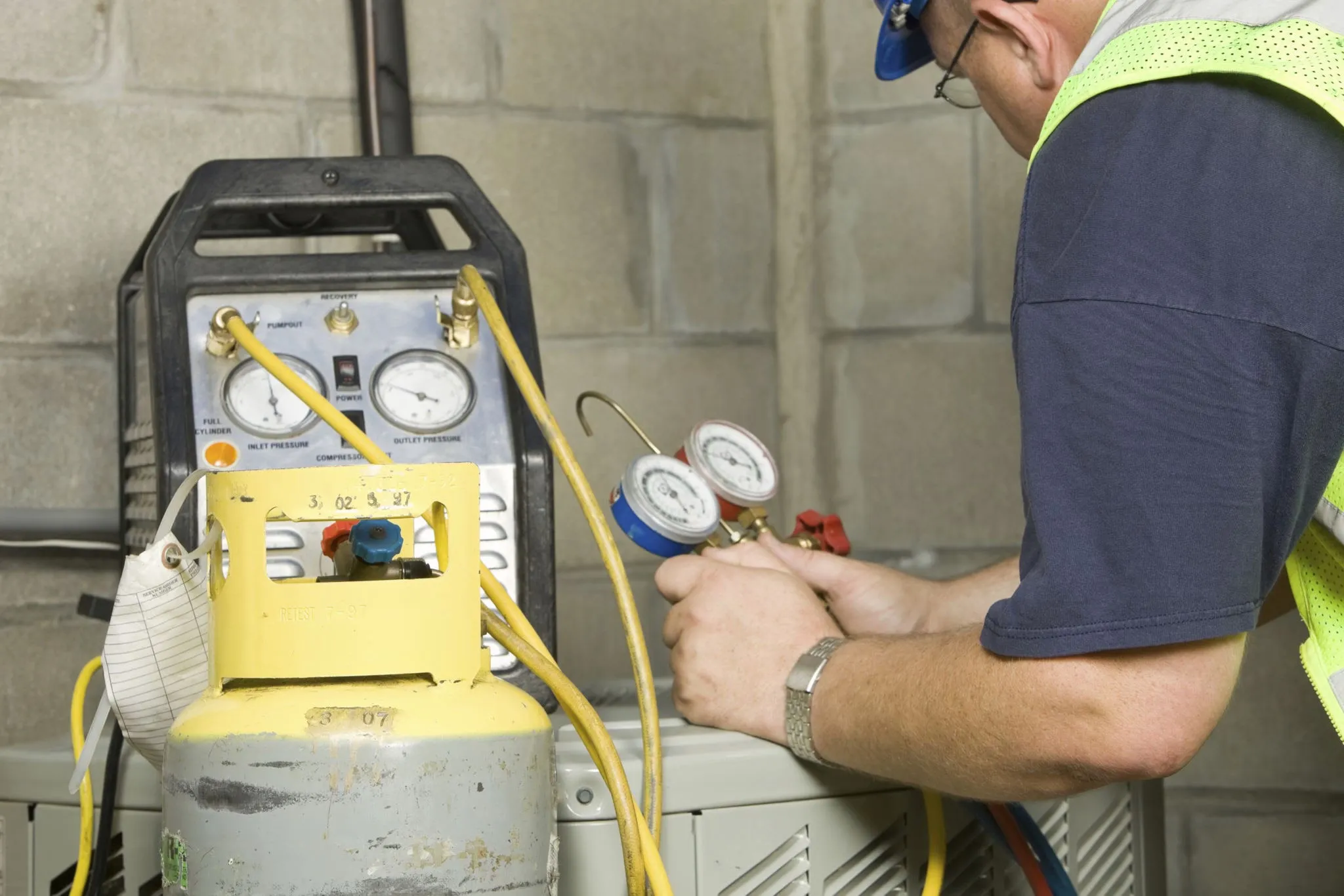
Proper refrigerant recovery equipment reduces environmental impact and complies with EPA regulations
Residential systems under 50 lb aren’t subject to EPA leak repair mandates, but Section 608 still prohibits venting. Leaks must be handled responsibly.
When Temporary Fixes Are Ethical
All must be true:
- No safety hazard or code violation
- Low pressure/vibration at repair site
- Written disclosure: what’s being done, why it’s temporary, expected lifespan, likely next failures
- Permanent and replacement options offered alongside
- Customer situation warrants bridge solution (budget timing, weather, critical needs)
Examples: Low-side patches away from compressor vibration; non-invasive airflow restoration; emergency stopgaps while planning replacement.
When to Walk Away
Do not offer a patch when:
- Structural integrity failing (rotted pans, collapsing plates, multiple pinholes)
- High-pressure/vibration zones near compressor discharge
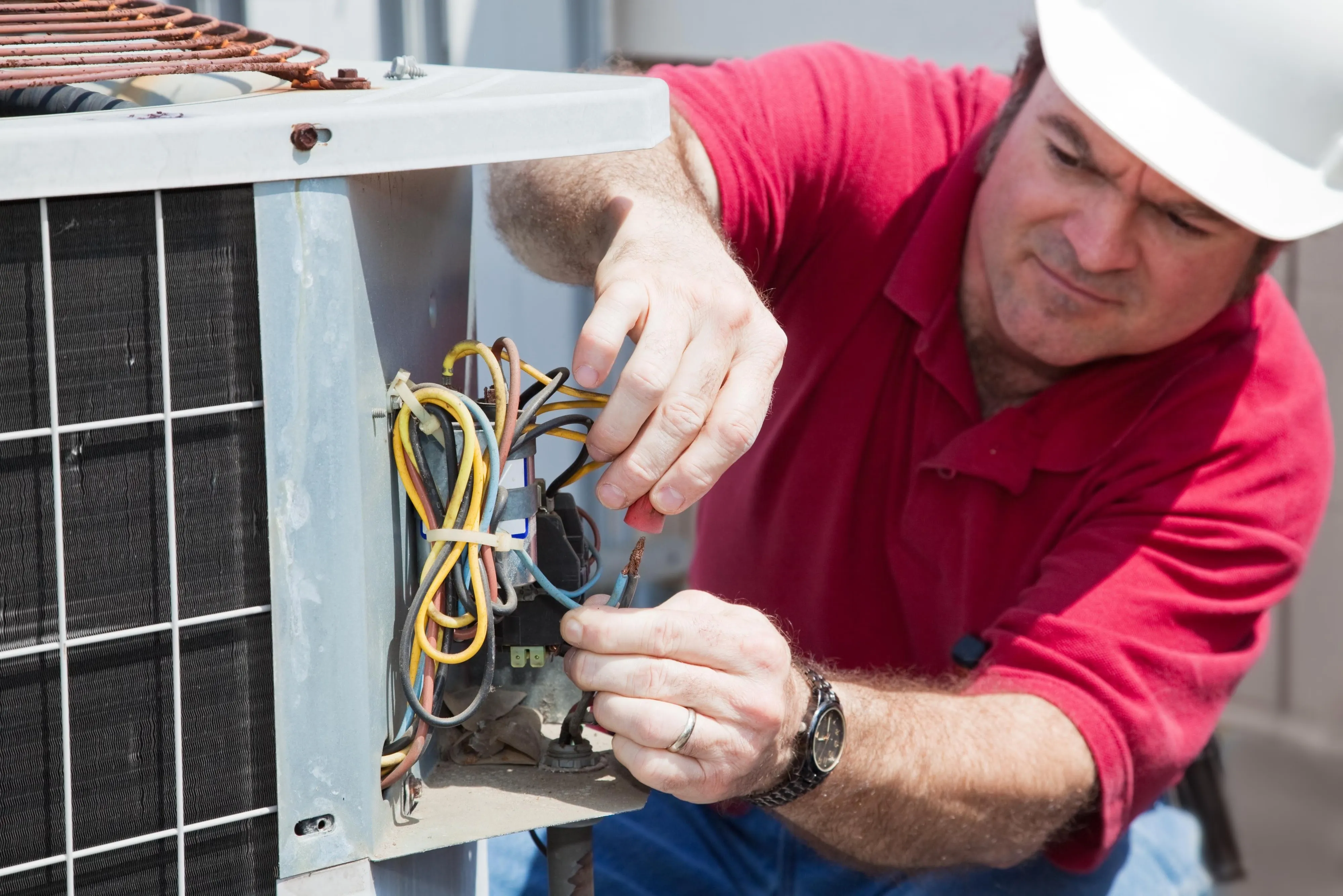
- Electrical hazards, improper protection, compromised insulation
- Combustion safety or venting concerns
Explain why, document risks, provide only permanent repair or replacement options.
Quick Scoring Tool
Score 0–2 per category:
| Category | 0 | 1 | 2 |
|---|---|---|---|
| Safety | Unsafe | Marginal | Safe |
| Structural | Failing | Borderline | Sound |
| Refrigerant | Obsolete | Mixed | Current |
| Warranty | Expired | Partial | Strong |
| Efficiency gap | Large | Moderate | Minor |
0–4: Replace likely best value | 5–7: Offer both with disclosures | 8–10: Durable repair favored
Override: If Safety=0 or Structural=0, do not offer repair.

Three-Option Estimate Template
| Option | Scope | Warranty | Price |
|---|---|---|---|
| Temporary Restore | [description] | 30–90 days | $[ ] |
| Durable Repair | Brazed repair/coil/compressor | 1 yr parts/labor | $[ ] |
| Full Replacement | [model/tonnage/SEER2] | 10-yr parts, 1–2 yr labor | $[ ]/mo financing |
Disclosure snippet: “I understand this is a temporary restore. I have been offered durable repair and replacement options and am choosing this option. Warranty terms: [X].”
Customer Decision Framework
- Safety — Can this be made safe without cutting corners?
- Integrity — Is the coil/pan/line set structurally sound?
- Context — Refrigerant, age, warranty status?
- Options — Temporary (if safe), durable repair, replacement with financing
- Disclosure — Written acknowledgement of recommendation and choice
- Next failure — Note likely failures and time horizons as ranges
Why This Earns Trust
Clear expectations reduce “you fixed one thing and another broke” frustration. The opening scenario’s tech offered three options. The customer chose the bridge, saved through fall, and replaced off-season at better pricing. Informed consent, no pressure, outcomes aligned with reality.
FAQ
Are leak sealants okay? Not manufacturer-approved for most systems; contaminate recovery equipment. Use proper leak locating and brazed repairs.
Can you recharge a system that leaks? EPA Section 608 prohibits venting. Locate and address leaks or present a plan with disclosure.
What about A2L refrigerants? R-32 and R-454B use lower GWP but require updated tools/training. Explain simply and provide safety sheets.
Does cleaning a very old evaporator coil make sense? If integrity is marginal, aggressive cleaning can cause leaks. Offer non-invasive restoration or replacement.
Sources
- DOE Energy Saver – Central Air Conditioning
- EPA Section 608 Refrigerant Management
- EPA Global Warming Potentials
- ACCA Quality Installation
- AHRI Directory
This article does not replace local codes, manufacturer instructions, or licensure requirements.
Try ShiftFlow’s workforce management platform to track warranties, manage customer decisions, and streamline operations.