How to Handle Employee Tardiness
Learn what employee tardiness means (chronic late arrivals to work), costs averaging $1,800 per employee annually, common causes including transportation and burnout, how to track patterns, and proven strategies to reduce chronic lateness.

What Is Employee Tardiness?
Employee tardiness is the pattern of habitual late arrival to scheduled work start times or shifts. While occasional lateness happens due to unexpected circumstances, tardiness refers to chronic patterns—arriving 5-15 minutes late multiple times weekly—that disrupt operations, affect team morale, and require management intervention.
Tardiness differs from absenteeism (missing entire shifts) and unauthorized absence (no-call, no-show situations). Tardy employees show up but consistently fail to arrive on time, creating cascading effects on workflow, customer service, and coworker responsibilities.
Quick Answer
Employee tardiness is chronic late arrival to scheduled shifts, costing businesses an average of $1,800 per employee annually. Common causes include transportation issues (35%), childcare problems (20%), sleep difficulties (15%), and disengagement (12%).
Approximately 20% of employees arrive late at least once weekly, with 5-10% qualifying as chronically tardy (late 2+ times weekly). These chronic cases account for 80% of tardiness-related costs and disruption.
How Much Does Employee Tardiness Cost?
Direct and Indirect Costs
Lost productivity: Employee paid $25/hour arriving 15 minutes late twice weekly loses $625 annually ($12.50 × 50 weeks).
Coverage costs: Supervisors or coworkers cover responsibilities at higher pay rates or overtime until tardy employee arrives.
Team productivity loss: Other workers wait for tardy employees to start collaborative work, creating bottlenecks.
Customer service delays: Late arrivals reduce coverage during opening hours or shift transitions.
Morale impact: Punctual employees resent covering for chronically late coworkers.
Administrative burden: Tracking tardiness, conducting conversations, documenting incidents.
Total cost example: Organization with 50 employees, 10% chronically tardy (5 employees): Direct wage loss $3,125 + Coverage costs $2,500 + Productivity loss $3,000 = $8,625 annually ($1,725 per tardy employee).
What Causes Employee Tardiness?
Transportation issues (35%): Traffic congestion, public transit delays, vehicle breakdowns, parking challenges, weather-related road conditions. Solutions include staggered shifts, flexible start times considering travel allowance policies, or remote work options.
Childcare challenges (20%): Daycare drop-off delays, school bus issues, nanny cancellations, sick children. Solutions include grace periods, backup childcare resources, flextime for school schedules.
Sleep problems (15%): Insomnia, sleep disorders, irregular sleep schedules from shift work, alarm failures. Workers on 3rd shift or rotating schedules struggle with sleep consistency.
Low engagement (12%): Tardiness increasing over time, declining performance, pattern of arriving just late enough to avoid consequence. Often shows other concerning behaviors.
Personal issues (10%): Elder care, medical appointments, financial stress requiring second jobs, relationship conflicts, substance abuse.
Poor time management (8%): Underestimating travel time, getting distracted during morning routine, inability to prioritize, procrastination on evening prep.

How Do You Track Employee Tardiness?
Define Standards and Track Systematically
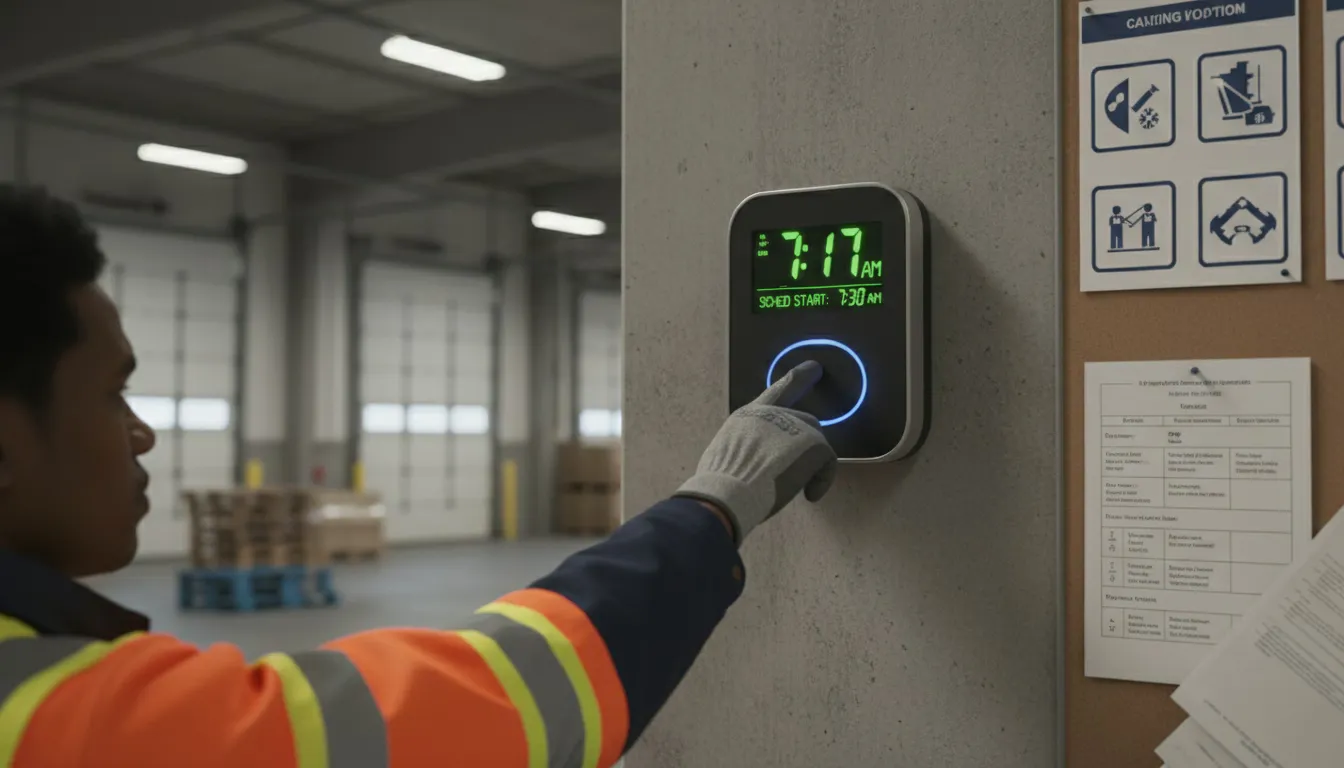
Define “late”: Establish clear standards (5-minute grace period, strict 8:01 AM start, or time clock rounding using 7-minute rule).
Use time clock systems: Digital time clocks capture exact clock-in times. Biometric systems prevent buddy punching. GPS mobile apps track field worker arrivals. Modern workforce management software automatically flags late arrivals.
Calculate metrics:
- Tardiness frequency: Number of late arrivals per month
- Total tardiness minutes: Sum of late minutes
- Tardiness rate: (Late arrivals ÷ Scheduled shifts) × 100
Example: Employee scheduled 20 days, late 4 times = Tardiness rate 20%. Rates above 10% warrant intervention.
Identify patterns: Day-of-week (Mondays, Fridays), time-of-day, seasonal (winter weather), event-related (after payday). Patterns reveal systemic issues versus individual problems.
How Do You Address Employee Tardiness?
Progressive Discipline Approach
Step 1: Private conversation. Meet individually to discuss pattern, express concern, ask about underlying causes, listen to explanations, offer support if legitimate barriers exist.
Step 2: Document everything. Maintain records of each late arrival (date, time, minutes late), conversations, employee explanations, improvement commitments, and disciplinary actions taken.
Step 3: Progressive discipline:
- Verbal warning: Informal conversation about pattern and expectations
- Written warning: Formal documentation noting specific instances
- Final written warning: Last chance notification before termination
- Termination: If pattern continues despite interventions
Step 4: Address root causes. Transportation issues: flexible start times, staggered shifts, remote work. Childcare: grace periods, backup resources. Sleep issues: medical evaluation, shift adjustments away from challenging 3rd shift hours. Disengagement: address job satisfaction through employee empowerment and improved workplace behavior standards.
Step 5: Set clear expectations. Specify exact arrival time, explain tracking method, define consequences, set review period (30-60 days), follow up regularly.
Step 6: Enforce consistently. Apply same standards to all employees. No favoritism or selective enforcement.

What Attendance Policies Reduce Tardiness?
Clear written policy in employee handbook covering definition of on-time arrival, grace periods if offered, required notification procedures, progressive discipline steps, and exceptions for emergencies.
Attendance point systems: Late 1-15 minutes = 0.5 points, 16-30 minutes = 1 point, over 30 minutes = 2 points, unauthorized absence = 3 points. Reaching threshold (8 points in 90 days) triggers discipline. Benefits include objectivity. Drawback is inability to distinguish emergencies from irresponsibility.
Flexible start times: Arrive anytime 7:30-9:00 AM, work 8 hours. Core hours (10 AM-3 PM present, flexible arrival/departure). Individual schedules based on commute and personal needs.
Incentives for good attendance: Perfect attendance bonuses, priority shift selection, recognition in meetings, additional PTO for excellent records. Caution: ensure incentives don’t discourage staying home when legitimately ill.

When Is Tardiness Legally Protected?
Disability accommodations (ADA): Medical appointments, medication side effects, mobility limitations, chronic conditions may require later start times or flexible schedules as reasonable accommodation.
FMLA intermittent leave: Workers using intermittent FMLA for chronic conditions or caring for ill family cannot be disciplined for FMLA-related tardiness.
Religious observances (Title VII): Religious services or prayers affecting work hours require reasonable accommodation.
Union contracts: Collective bargaining agreements may specify grace periods, discipline procedures, or grievance processes for attendance disputes.
The Bottom Line
Employee tardiness is chronic late arrival to scheduled work, costing U.S. businesses $3 billion annually or $1,800 per chronically tardy employee. Common causes include transportation issues (35%), childcare challenges (20%), sleep problems (15%), and low engagement (12%).
Track tardiness using automated time clock systems that capture exact arrival times, calculate frequency and total minutes late, and identify patterns by day or shift. Address chronic tardiness through private conversations to understand root causes, progressive discipline (verbal warning, written warning, final warning, termination), and solutions addressing underlying issues like flexible start times.
Effective attendance policies include clear written standards, attendance point systems for objective tracking, flexible start time options, and consistent enforcement. Certain tardiness may be legally protected under ADA reasonable accommodations, FMLA intermittent leave, religious observances, or union contract provisions.
Use workforce management tools to automate tardiness tracking, flag concerning patterns related to specific shifts like split shifts, manage attendance policies consistently, and integrate with your employee roster planning to address systematic issues.
Sources
- U.S. Bureau of Labor Statistics – Worker Productivity Statistics
- U.S. Department of Labor – Fair Labor Standards Act
- U.S. Equal Employment Opportunity Commission – ADA Regulations
Further Reading
Frequently Asked Questions
What is employee tardiness?
Employee tardiness is the pattern of chronic late arrival to scheduled work shifts. While occasional lateness happens, tardiness refers to habitual patterns—arriving 5-15 minutes late multiple times weekly—disrupting operations and team workflow.
How much does employee tardiness cost?
Employee tardiness costs U.S. businesses approximately $3 billion annually. Individual organizations lose an average of $1,800 per chronically tardy employee per year through lost productivity, coverage costs, and team morale impacts.
What causes employee tardiness?
Common causes include transportation issues (traffic, transit delays), childcare challenges, sleep problems and oversleeping, low engagement or job dissatisfaction, personal or family issues, and poor time management skills.
How do you address employee tardiness?
Address tardiness through private conversations to understand root causes, clear attendance policies with defined standards, automated tracking systems, progressive discipline (verbal warning through termination), and solutions addressing underlying barriers like flexible scheduling.
When is tardiness legally protected?
Tardiness may be protected under ADA reasonable accommodations for disability-related medical needs, FMLA intermittent leave for serious health conditions, Title VII religious observances, or union contract provisions requiring specific grace periods or procedures.
What is the difference between tardiness and absenteeism?
Tardiness is arriving late (5-30 minutes) to scheduled shifts, causing workflow disruption and costing $5-$25 per incident. Absenteeism is missing entire shifts, causing complete worker absence and costing $150-$400 per occurrence.
How many times late is considered chronic tardiness?
Most organizations consider 2+ late arrivals per week or 8+ occurrences per month as chronic tardiness warranting intervention. Occasional lateness (1-2 times monthly) is typically tolerated for otherwise reliable employees.
Can you fire someone for being late?
Yes, employers can terminate for chronic tardiness if they communicated clear attendance policies, applied policies consistently, used progressive discipline, documented all incidents, and ensured tardiness was not legally protected (ADA, FMLA, religious accommodation).